2000 BCE - 0 CE · The long formation of the biblical world before Christianity.
This Age examines the long formation of the biblical world before Christianity. It traces how Israelite religion emerged from the cultures of the ancient Near East, and how its texts, beliefs, and identity were constructed, edited, and reshaped across centuries of political collapse, exile, and foreign rule.
At the beginning of this Age, there is no Israel, no Bible, and no Yahweh as a singular god. There is a region.
The eastern Mediterranean and Near East form a continuous cultural zone, linking Egypt, the Levant, and Mesopotamia. Languages, myths, laws, and religious ideas move across this region through trade, conquest, and migration. The peoples who later appear in the Bible are part of this shared world, not separate from it.
The early Israelites emerge from within this environment. Archaeological evidence places their origins in the central highlands of Canaan, where small, rural settlements appear after the collapse of the Bronze Age city-state system around 1200 BCE. These communities are not foreign invaders. They are local populations reorganizing after systemic collapse.
Early Israelite belief is not monotheistic. It is part of the wider Canaanite system. The chief god is El. Other deities, including Asherah and Baal, are widely venerated. Yahweh appears later, likely originating from southern regions, and gradually merges with El, absorbing his role. The shift from polytheism to exclusive Yahweh worship is slow, contested, and incomplete for centuries.
This is not the birth of a religion. It is the evolution of one.
The formation of the kingdoms of Israel and Judah introduces centralization, but it does not produce religious unity. The northern kingdom remains cosmopolitan and syncretic. The southern kingdom, centered on Jerusalem, begins to push toward exclusivity, especially under reforming kings such as Hezekiah and Josiah. These reforms are not simply religious. They are administrative and ideological. They attempt to concentrate power, control worship, and define identity.
They also begin the first major act of rewriting. Texts are composed, edited, and arranged to support these reforms. Earlier diversity is not erased, but it is reframed. Multiple voices remain embedded within the text, often in tension with one another.
The decisive break comes with collapse. In 586 BCE, the Babylonian conquest destroys Jerusalem and the Temple. The political system collapses. The cult collapses. The old framework no longer functions. In exile, scribes begin to compile, edit, and reinterpret the traditions that will become the Hebrew Bible. They construct a narrative that explains defeat as divine judgment and survival as evidence of covenant. This is the first great reconstruction of memory.
What emerges is not a simple record of the past. It is a curated past, shaped to sustain identity without land, king, or temple.
The return under Persian rule does not restore the old system. It produces a new one. Religion becomes increasingly textual. Authority shifts toward law, scribes, and interpretation. The Torah is elevated as a foundational document. Identity is defined through adherence rather than territory.
Under Greek and then Roman rule, external pressure produces internal diversification: priestly elites tied to the Temple; legal scholars emphasizing interpretation; separatist communities; apocalyptic movements expecting divine intervention. By the first century CE, the landscape is fragmented, dynamic, and unstable. This is the world into which Christianity will emerge.
This Age establishes the foundation that later traditions will claim as fixed. It shows that:
What later appears as a stable origin is, in fact, the result of continuous adaptation and reconstruction.
Age I is also a book: The Jealous God. Here is an early preview - a taste of what is coming across the series.
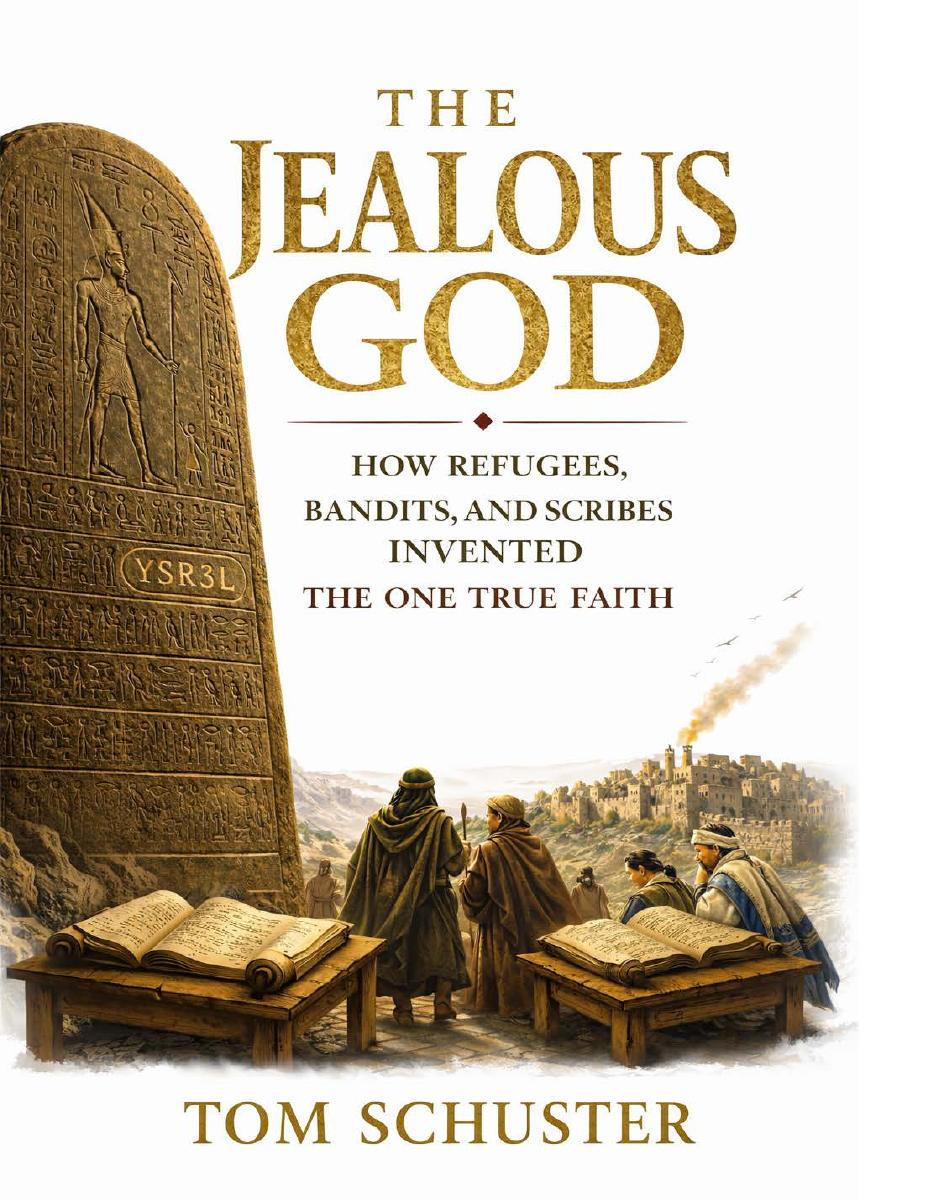
Egypt, Mesopotamia, and the Levant as an interconnected ancient Near Eastern system.
Coming soonFrom Canaanite society to early kingdoms; the emergence of Yahweh.
Coming soonExile, text, and identity: the Babylonian captivity and the compilation of the Hebrew Bible.
Coming soonJudaism under empire: diversification, apocalyptic, and messianic frameworks.
Coming soonThe Age I preview. Sixty pages on how the biblical world was formed before Christianity.
One email a month at most. Unsubscribe any time. See our privacy page.