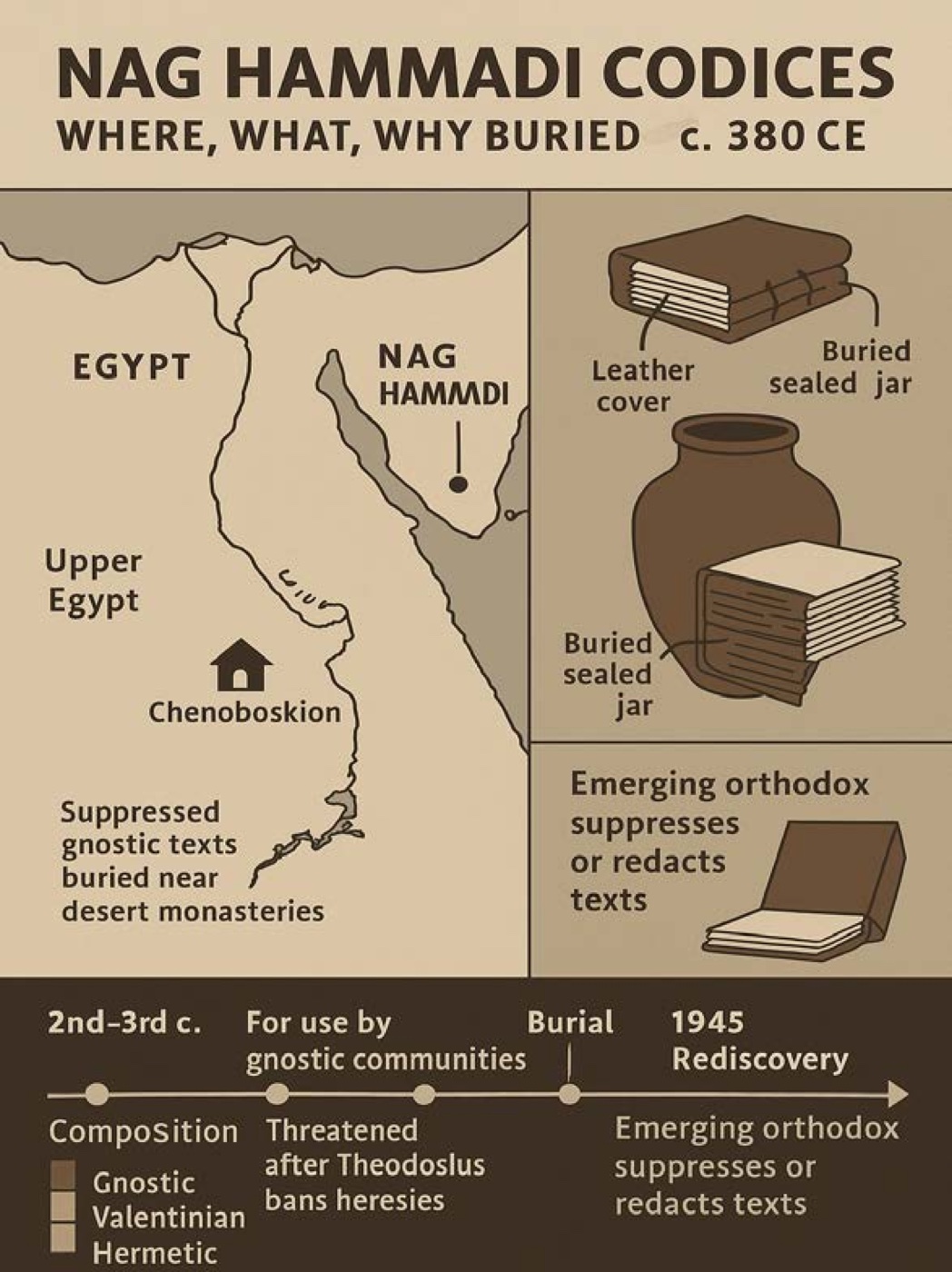
In 1945, in the dry hills above the Nile, two farmers struck something solid. Inside the jar were thirteen leather-bound books - not fragments, not debris - a complete map of Christianities that did not survive. This is the world those books came from.
Season 1 · Episode 7
This episode begins with the Nag Hammadi jar and the library it preserved, then steps back into Egypt as the most theologically saturated landscape in the early Christian world. It follows the many Christian paths that flourished there: Valentinian reflection, symbolic gospels, cosmic reinterpretations of Genesis, desert asceticism, and communities where interpretation was still open.
The episode opens in 1945, with the discovery of the Nag Hammadi codices: thirteen leather-bound books buried in the Egyptian desert, containing gospels, revelations, hymns, dialogues, and cosmologies that preserved forms of Christianity later excluded from the surviving tradition. The jar matters not as a curiosity, but as evidence. These books were not scraps from the margins. They were a map of Christianities that once lived openly and later disappeared.
Christianity entered not an empty province, but a world already saturated with myth, symbolism, allegory, and layered accounts of creation, death, renewal, and divine process. Greek remained the language of philosophy and theological argument, while Coptic became the language in which Christianity entered villages, monasteries, and daily prayer. In that setting, Egypt produced not one Christianity but several at once: Alexandrian allegorical reading, Nile-valley cosmological speculation, and desert ascetic transformation.
Valentinus appears as one of the clearest expressions of this Egyptian Christianity of understanding. He was not presented as marginal or rebellious, but as educated, scripturally serious, and deeply concerned with what Christianity meant. In his vision, the world was fractured not simply by sin but by a deeper rupture associated with Sophia, Wisdom. Salvation therefore became not legal acquittal but restoration through knowledge, recognition, and healed understanding. This Christianity was often more ascetic than its proto-orthodox rivals, and it treated authority as something flowing from insight rather than office.
The Nag Hammadi library is read here as a coherent symbolic universe. The Gospel of Thomas presents Jesus as a revealer who trains perception rather than directing attention toward a final apocalypse. The Gospel of Philip reinterprets sacraments as illumination, recognition, and union. The Gospel of Mary and the Gospel of Judas show how radically early Christians could disagree about authority, discipleship, and the meaning of Jesus’ death. The Apocryphon of John rewrites Genesis as a drama of error, ignorance, and awakening, while Thunder, Perfect Mind gives voice to a divine feminine presence that cannot be contained by later doctrinal categories. Taken together, these books reveal not confusion but another Christian world running parallel to the one that survived.
The final movement turns from texts to the desert. Anthony the Great appears not as a theologian or organizer, but as a figure of endurance, someone whose authority rested in visible discipline and survival rather than in office or system. Around him and after him, the Egyptian desert filled with ascetics, both men and women, whose Christianity was learned by doing. These desert communities still overlapped, in symbolic language and spiritual imagination, with the wider Egyptian Christian world represented by the Nag Hammadi texts. Nothing had yet forced a clean separation. Meaning still overlapped. Authority was still earned. The system had not yet arrived.
Key themesNag Hammadi as evidence of erased Christian worlds; Egypt as a layered religious universe; Greek and Coptic Christianity; Valentinus and Christianity as understanding; Thomas, Philip, Mary, Judas, and the Apocryphon of John; revelation as poetry in Thunder, Perfect Mind; Anthony and the desert of endurance; ascetic charisma without system; Egypt before doctrinal control.