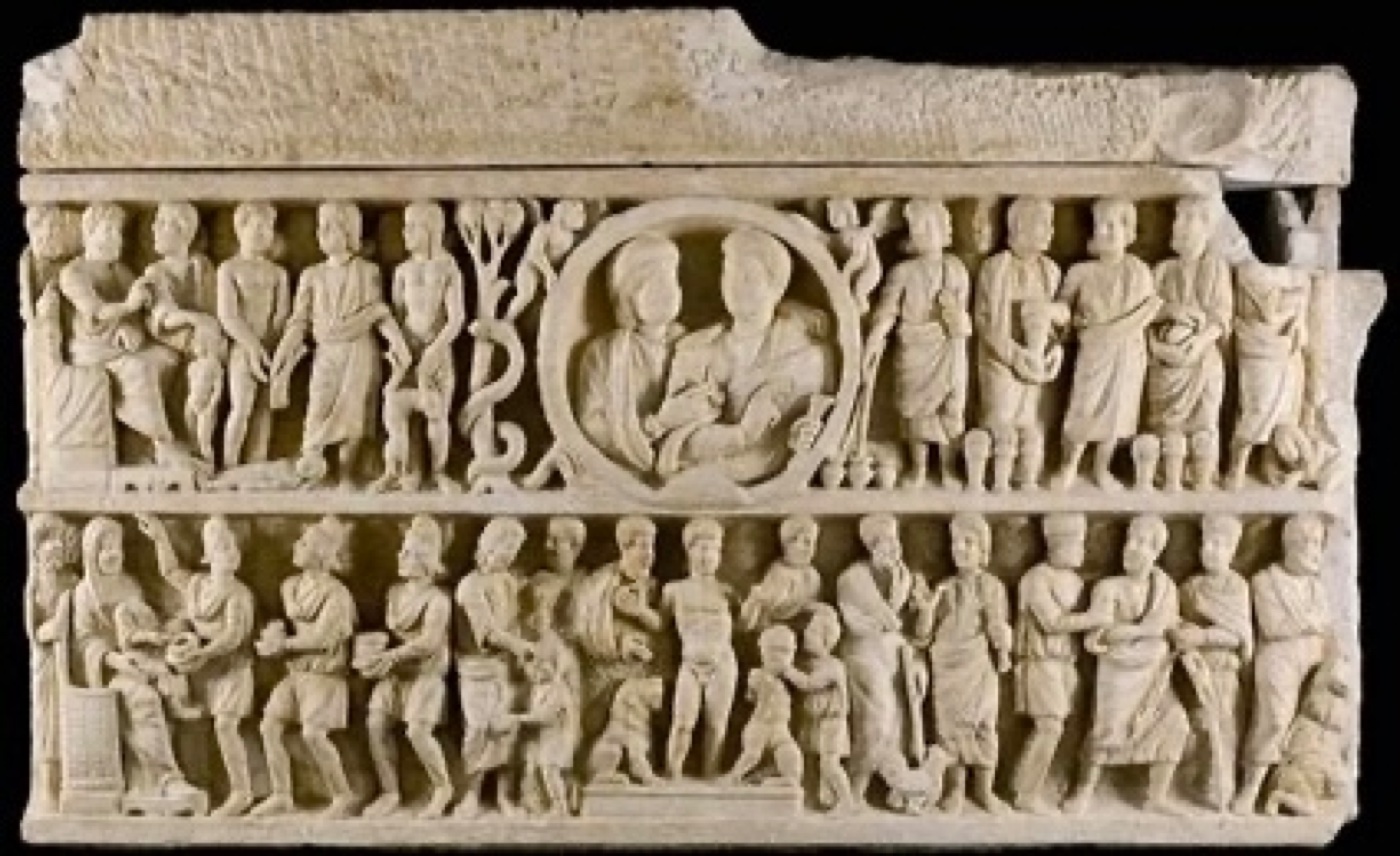
313 CE - The Edict of Milan. The year Christianity became a legally recognized religion of the Roman Empire. The turning point at which Christianity moved from private networks into public life. Does not create orthodoxy; creates the conditions in which orthodoxy could be selected.
380 CE - The Edict of Thessalonica. The year Nicene Christianity became the only legal religion of the empire. The moment when theological deviation became punishable by law rather than merely disputed in public.
39th Festal Letter (367 CE). The letter by Athanasius, bishop of Alexandria, that named the twenty-seven books of the New Testament and explicitly excluded others. Decisive because, inside the disciplined Egyptian monastic networks, it could be enforced.
Age I - Before the Filter. The religious inheritance of the biblical world before Christianity: ancient Near Eastern traditions, the formation of Israelite religion, and Second Temple Judaism. 2000 BCE - 0 CE.
Age II - The Winner’s Tale. The first five centuries of Christianity, marked by diversity, experimentation, and the gradual emergence of canon, creed, and centralized authority under imperial pressure. 0 - 500 CE.
Apostolic Succession. The later claim of an unbroken line of authority from the apostles through bishops. Constructed retrospectively and unevenly applied; in the first two centuries it functions more as norm-setting than as documented continuity.
Arianism. The fourth-century position, associated with the Alexandrian priest Arius, that the Son is subordinate to the Father. The central theological dispute around which the Council of Nicaea in 325 CE was organized.
Canon. A closed list of scriptural texts. No fixed canon existed in the first three centuries of Christianity. Local churches used overlapping but different collections, and what counted as authoritative was contested for generations.
Catechetical School. A teaching center in which Scripture was studied with the tools of philosophy and disciplined interpretation. The Alexandrian school - associated with Clement and Origen - is the best-known example.
Cenobitic Monasticism. Communal monastic life governed by a rule. Developed at scale by Pachomius in fourth-century Egypt, it introduced regulated time, shared labor, and obedience culture to Christian practice - and, indirectly, the infrastructure through which canon could later be enforced.
Council of Nicaea (325 CE). The imperial council convened by Constantine to resolve the Arian controversy. It produced a creed but not immediate unity; its vocabulary (“of one substance with the Father”) became an instrument of exclusion rather than the end of debate.
Didache. An early Christian teaching manual covering baptism, fasting, prayer, and community discipline. Widely used in the second century and later excluded from the canon.
Filter, The. The central analytic concept of the series: the gradual narrowing of Christian diversity through persecution, canon formation, episcopal organization, and imperial law. Orthodoxy emerged from the Filter, not from open theological victory.
Gnosis. Knowledge as transformative insight rather than as information. Central to a family of early Christian communities for whom salvation was understood as awakening.
Gnostic. A modern scholarly label for a diverse set of early Christian groups that emphasized revelation, symbolic interpretation, and cosmic mythology. Not a unified movement; useful only with caveats.
Hexapla. Origen’s six-column comparison of different Greek and Hebrew versions of the Old Testament, produced in the third century. Largely lost, but a landmark in early Christian scholarship.
Jewish Christianity. The family of early communities that continued to observe Torah, remain within Jewish life, and read Israel’s scriptures as their own while affirming Jesus as messiah. Did not disappear through defeat in argument; declined under displacement, language shift, and imperial pressure.
Martyrdom. Public refusal to perform civic ritual at the cost of one’s life. In Roman North Africa especially, it functioned as a form of moral testimony, identity formation, and communal memory rather than simple persecution narrative.
Monasticism. A disciplined way of Christian life emphasizing withdrawal, ascetic practice, prayer, and obedience. Develops first in the Egyptian desert in the third and fourth centuries.
Nag Hammadi Library. A cache of thirteen leather-bound codices discovered in 1945 in Upper Egypt, containing gospels, revelations, dialogues, and cosmologies preserving forms of Christianity later excluded from the canon. Buried around the fourth century. Evidence that Christian diversity was once both widespread and textually sophisticated.
Orthodoxy. A later designation, not a self-evident category in the first three centuries. What became orthodoxy was the stream of Christianity that developed the most durable institutions and that imperial power could most easily amplify.
Pauline Christianity. The forms of early Christianity shaped by the letters of Paul - emphasizing faith apart from the Law, the inclusion of gentiles, and the cross as the center of identity.
Proto-Orthodox. A modern scholarly term for the stream of Christianity that later gained imperial recognition and became the dominant form. Used to avoid projecting later orthodoxy backward onto communities that did not yet think in those terms.
Septuagint. The Greek translation of the Hebrew Scriptures produced in Alexandria beginning in the third century BCE. The version most often used by Paul and the authors of the New Testament.
Sophia. Wisdom personified. A key figure in Jewish wisdom literature and in Valentinian and other early Christian theology, where her “fall” is sometimes the cosmic drama out of which salvation emerges.
Valentinus. A second-century Alexandrian teacher whose symbolic, philosophically sophisticated theology was widely influential in the second and third centuries before being condemned. His writings and those of his school are among the most important sources for what later orthodoxy excluded.
Glossary is Season 1 focused. Season 2 terms - synoptic problem, fulfillment formula, Logos, canon criticism, redaction, and others - will be added.
The Age I preview. Sixty pages on how the biblical world was formed before Christianity.
One email a month at most. Unsubscribe any time. See our privacy page.