How Mark ⟦Was Changed⟧
The earliest gospel did not stay as it was written. Once Mark began to be copied, scribes softened it, matched it to the other gospels, added lines it never had and gave it an ending its author never wrote. This is the record of those changes, verse by verse.
Scope: sixteen readings in Mark, grouped by the kind of change rather than by chapter.
Caveat carried throughout: the manuscript trail begins in the late 2nd and 3rd centuries. What happened to Mark in its first hundred years has to be reconstructed backwards from what survives.
A rough text under pressure
Mark is the earliest gospel and it reads like it. The Greek is plain and hurried, the transitions are abrupt, the disciples are dense, the Messiah suffers and is misunderstood and the story stops without a single resurrection appearance. Every quality that makes Mark valuable to a historian made it awkward for the communities that had to carry it.
The moment a text is copied by hand, copying becomes choosing. A scribe decides what to reproduce and how and small decisions accumulate. When Mark travelled beyond the small community it was written for and especially once it was read alongside Matthew, Luke and John, its rough edges stopped looking like character and started looking like problems. The manuscript tradition is the record of people solving those problems.
What is striking is that the solutions are not random. They fall into four recognisable moves. A harsh saying is softened. A detail that clashes with another gospel is harmonised. A missing word or explanation is expanded in. And the unbearable open ending is, at last, ended. Read together, the changes are a portrait of what the later church needed the earliest gospel to be.
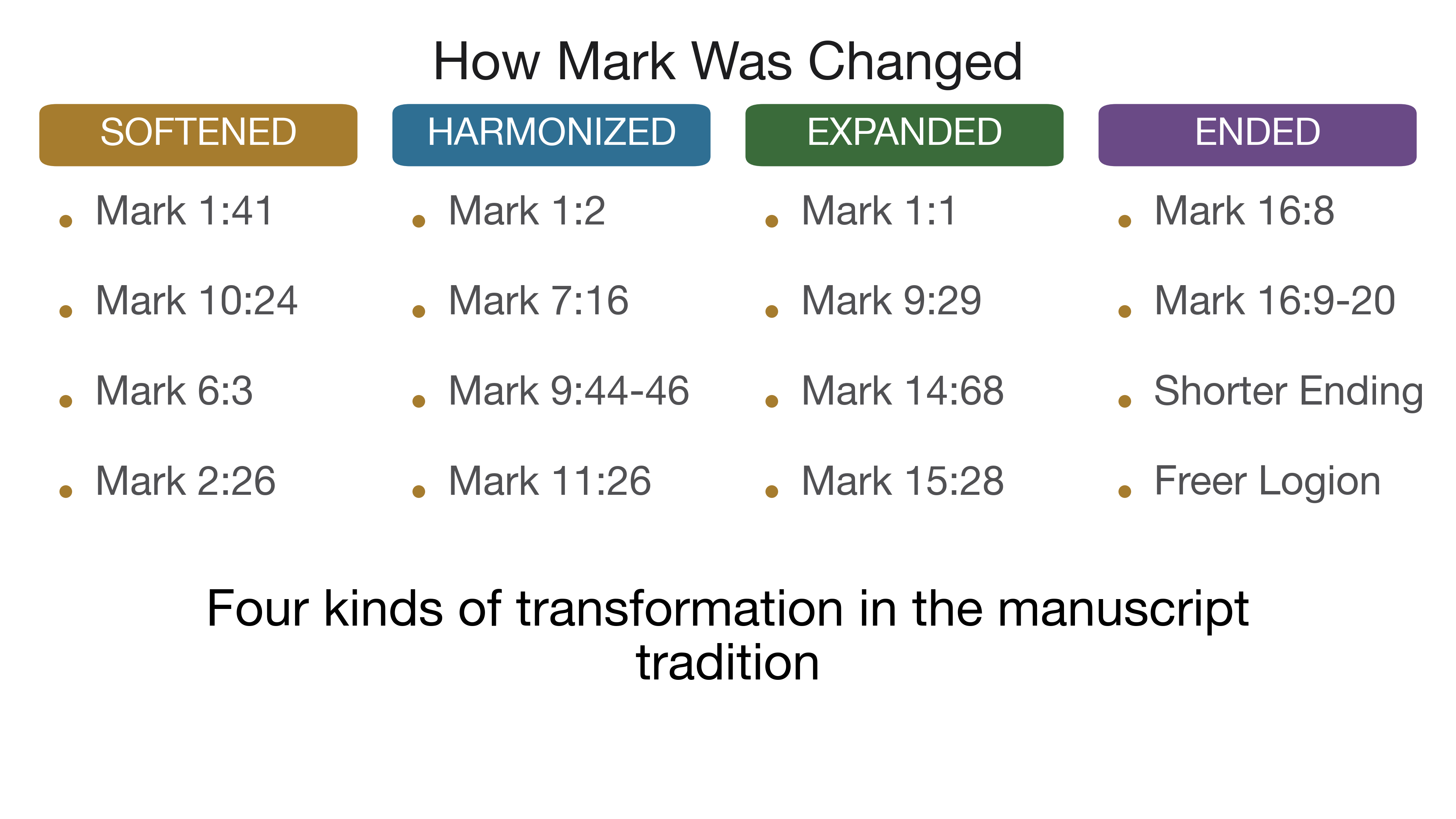
What kind of change and why
Each move answers a different discomfort. Softening protects Jesus and the message from embarrassment. Harmonising protects the fourfold gospel from self-contradiction. Expansion supplies what a later reader expects to find. And the endings supply the closure Mark deliberately withheld.
The harsh edge eased
An angry Jesus becomes a compassionate one. A blanket warning about wealth is narrowed to a warning about the love of wealth. A carpenter becomes a carpenter's son. A factual slip is quietly removed. Nothing here is invented; the sharpest version is simply made easier to preach.
Made to match the others
Once four gospels are read as one canon, they are expected to agree. A misattributed quotation is corrected. Refrain lines from elsewhere in Mark are supplied where the reader feels their absence. A verse is pulled across from Matthew to fill a gap. Mark is nudged toward the sound of the whole.
What was missing, supplied
A title is filled out. An ascetic practice is written into a saying about prayer. A sound effect is added so a scene fits its own prophecy. An interpretive line is inserted so the text says out loud what it had only implied. Resonance is turned into declaration.
The open ending closed
Mark stops at fear and silence, with no appearances and no commission. The tradition could not live with that. It produced a long ending, a short ending and even an expansion within the long ending. The manuscripts preserve not one solution but several and that hesitation is itself the evidence.
All sixteen readings
Tap a move to isolate it. ★ marks readings where scholars genuinely dispute the direction of change - whether a word was added later or deliberately removed - so the "secondary" verdict is held loosely.
| Reading | What changes | The witnesses | Move | Secondary? |
|---|---|---|---|---|
| 1:41Mark | Anger softened to compassionHealing the leper, Jesus is "moved with orgē" (anger) - later smoothed to "moved with compassion" | "anger" in D + Old Latin; "compassion" in ℵ B, most | Softened | 5★ |
| 10:24Mark | A qualifier that narrows the warning"how hard it is to enter the kingdom" gains "for those who trust in riches" - wealth in itself becomes trust in wealth | short in ℵ B; qualified in A D Θ Byz, most | Softened | 9 |
| 6:3Mark | "The carpenter" moved off Jesus"Is not this the carpenter?" reworded in a minority line to "the son of the carpenter," sparing Jesus the trade | "carpenter" in ℵ B D; softened in P45, f13, 33; Origen notes it | Softened | 6★ |
| 2:26Mark | A factual slip removed"when Abiathar was high priest" - it was Ahimelech (1 Sam 21). Some copies drop the phrase to erase the error | phrase in ℵ B, most; omitted by D W + Old Latin & Syriac | Softened | 8 |
| 1:2Mark | A misattributed quotation corrected"as it is written in Isaiah the prophet" - but the words are Malachi plus Isaiah, so scribes change it to "in the prophets" | "Isaiah" in ℵ B D L; "the prophets" in A W Byz | Harmonised | 9 |
| 7:16Mark | A refrain supplied"If anyone has ears to hear, let him hear" added from Mark's own 4:9 and 4:23; bracketed in modern editions | absent ℵ B L Δ; present A D Θ Byz | Harmonised | 9 |
| 9:44-46Mark | Two verses doubled in"where their worm does not die..." copied twice from 9:48, so the refrain lands three times instead of once | absent ℵ B C L W; present A D Θ Byz | Harmonised | 9 |
| 11:26Mark | A verse imported from Matthew"But if you do not forgive, neither will your Father..." lifted from Matt 6:15 to complete the saying | absent ℵ B L W Ψ; present A C D Θ Byz | Harmonised | 9 |
| 1:1Mark | "the Son of God" in the opening lineThe gospel's very first sentence: some early witnesses lack the title, raising whether it was original or added | present ℵ¹ B D W; absent ℵ* Θ 28, Origen | Expanded | 5★ |
| 9:29Mark | "and fasting" added"This kind comes out only by prayer" gains "and fasting," writing later ascetic practice into Jesus' words | "prayer" alone in ℵ* B; "and fasting" in ℵ² A C D Byz | Expanded | 8 |
| 14:68Mark | "and the cock crowed" insertedAdded after Peter's first denial so the scene fits Jesus' "before the cock crows twice" prophecy | absent ℵ B L W; present A C D Θ Byz | Expanded | 7 |
| 15:28Mark | An explicit fulfilment line"And the scripture was fulfilled, 'He was numbered with the transgressors'" (Isa 53:12) added at the crucifixion | absent ℵ A B C D; present L Θ Byz + Old Latin | Expanded | 8 |
| 16:8Mark | The original stopThe earliest strong ending closes on the women's fear and silence, with no resurrection appearance | the ending in ℵ B, Sinaitic Syriac; Eusebius & Jerome say most copies stopped here | Ended | 9 |
| 16:9-20Mark | The Long EndingAppearances, the Great Commission, snake-handling and poison immunity - appended to a gospel that ended at 16:8, in un-Markan style | absent ℵ B, Sin. Syriac; present A C D W Θ Byz | Ended | 10 |
| Shorter EndingMark | A second, briefer closeThe women report "briefly to those around Peter," then a one-sentence commission - a rival solution to the same gap | L Ψ 083 099 0112, usually placed before the Long Ending | Ended | 9 |
| Freer LogionMark | An expansion inside the Long EndingA dialogue added after 16:14 in which the disciples excuse themselves and Christ answers about "the limit of the years of Satan's power" | Codex Washingtonianus (W); described by Jerome | Ended | 9 |
Secondary? = confidence the reading is a later change rather than original (higher = more certain). ★ = direction of change genuinely disputed · ℵ = Sinaiticus, B = Vaticanus, D = Bezae, W = Washingtonianus, P45 = papyrus 45, Byz = the Byzantine majority.
The harsh edge eased
Mark's Jesus is the most human of the four. He is exhausted, exasperated, sometimes angry and his family and neighbours doubt him. Later readers, meeting this Jesus in isolation, found some of it hard to bear and the copyists eased it.
Mark 1:41 - the angry healer
When a leper begs to be cleansed, the harder reading - "moved with anger" - appears in a sparse line of early witnesses: Codex Bezae and the Old Latin tradition. Almost all other copies substitute "moved with compassion" (splanchnistheis). The harder reading is usually the older one, since scribes more often ease difficulties than they create them. What matters is the pattern: whether Jesus was angry at the disease, at the exclusionary system around the man, or at something else in the scene, the angry version is the one a later community would desire to remove. This sentence is Mark's clearest window into the work of scribes - they were not just transcribing text but preserving a portrait of Jesus that matched their own convictions.
Mark 10:24 - from wealth to the love of wealth
After the rich man walks away, Jesus tells the stunned disciples how hard it is "to enter the kingdom of God." Full stop, in the earliest witnesses. A large part of the tradition adds a qualifier: how hard it is "for those who trust in riches." The addition changes the target. The unqualified saying indicts wealth itself; the qualified saying indicts only a bad attitude to wealth, which is far easier to preach in a city church that depends on wealthy patrons and donors. A single inserted phrase turns a destabilising demand into a manageable one.
Mark 6:3 - the carpenter
In Mark, the townsfolk sneer, "Is not this the carpenter, the son of Mary?" That Jesus himself worked a trade and that he is named through his mother rather than a father, both carried an edge. A minority line - including, so far as its damaged text can be read, the early papyrus P45 - reads instead "the son of the carpenter," which is also Matthew's wording. Origen knew copies that avoided calling Jesus a carpenter outright. The change is small and its direction is debated, but the pressure is clear: later piety was uneasy with a labouring Messiah.
Mark 2:26 - Abiathar the high priest
Defending his disciples for plucking grain, Jesus recalls David eating the consecrated bread "when Abiathar was high priest." In 1 Samuel the priest is Ahimelech, Abiathar's father. It is a genuine slip and some manuscripts - Bezae, Washingtonianus, several Old Latin and Syriac copies - simply drop the phrase, healing the error by omission. The harder reading, with the mistake intact, is the older one. Here the softening protects not Jesus' feelings but his accuracy.
Made to match the others
The largest single force acting on Mark was the company it came to keep. Once Irenaeus and others fixed the gospels at exactly four, around 180 CE, the four were expected to agree. A scribe copying Mark with Matthew and Luke in his memory would, half-consciously, bring Mark into line - correcting, completing and smoothing toward the sound of the whole.
Mark 1:2 - "in Isaiah" or "in the prophets"
Mark opens his citation with "as it is written in Isaiah the prophet," then quotes a blend of Malachi 3:1 and Isaiah 40:3. The attribution is imprecise and the earliest witnesses keep it anyway. The majority tradition tidies it to "in the prophets," which is true to the mixed source and removes the embarrassment. The correction is exactly what an attentive, canon-minded scribe would make.
Mark 7:16 and 9:44-46 - the supplied refrains
Two of Mark's most famous "missing verses" are missing because they were added and later removed again by modern editors. Mark 7:16, "If anyone has ears to hear, let him hear," is a refrain Mark genuinely uses elsewhere (4:9, 4:23), so a scribe who felt its absence supplied it. Mark 9:44 and 9:46 repeat "where their worm does not die and the fire is not quenched," copied in from 9:48 so the line tolls three times. Neither is in the earliest manuscripts. When modern Bibles follow those manuscripts, the verses vanish into footnotes and the numbering skips - which is why readers think verses have been "taken out of the Bible." The truth is the reverse: they were put in.
Mark 11:26 - the imported verse
After the saying on forgiveness in prayer, many manuscripts add, "But if you do not forgive, neither will your Father in heaven forgive your trespasses." The line is lifted almost word for word from Matthew 6:15. It is absent from the best witnesses to Mark and present in the Byzantine majority - a clean case of one gospel completing another.
What was missing, supplied
Where softening removes and harmonising matches, expansion adds - a title, a word, a sound, a sentence - to give a later reader what the earliest text left implicit.
Mark 1:1 - "the Son of God"
The gospel's opening line reads, in most witnesses, "The beginning of the good news of Jesus Christ, the Son of God." A few important early witnesses, including the original hand of Sinaiticus and Origen's citations, lack the title. The debate is unusually finely balanced. It may be an accidental drop: in Greek the sacred names were abbreviated to their first and last letters with a stroke above and the line ended in a stack of such abbreviations that could invite an eye-skip. Or the title may be a deliberate enrichment of the gospel's very first sentence. Either way, the opening frame of Mark is not perfectly stable, which is a startling place for instability to sit.
Mark 9:29 - "and fasting"
Unable to cast out a spirit, the disciples are told, "This kind cannot come out by anything but prayer." The earliest witnesses stop there. Later copies add "and fasting," writing a developed ascetic discipline back into the mouth of Jesus. It is one of the clearest cases of a community's practice reshaping the text that was supposed to authorise it.
Mark 14:68 - the added cockcrow
Jesus predicts that Peter will deny him three times "before the cock crows twice." For the two crows to work, Mark needs a first crow after the first denial. The earliest witnesses do not have one; many later copies insert "and the cock crowed" at 14:68 so the narrative machinery matches its own prophecy. A small sound effect, added to make the story keep its promise.
Mark 15:28 - the fulfilment line
At the crucifixion, some manuscripts add, "And the scripture was fulfilled that says, 'And he was counted among the lawless,'" quoting Isaiah 53:12. Mark's passion is already saturated with scripture, but it works by allusion, letting the reader feel the echo. This addition drags the echo into the open and states it. It turns resonance into declaration - the instinct of a community that wants the meaning nailed down rather than sensed.
The open ending closed
Everything else in this record is a touch here and a word there. The ending is the great exception - the largest and most consequential change in the gospel and the one the manuscripts document most vividly, because they preserve the church trying more than one answer.
Mark 16:8 - fear and silence
The earliest strong ending of Mark stops mid-scene. The women find the tomb empty, are told he is risen and flee: "and they said nothing to anyone, for they were afraid." There is no appearance of the risen Jesus, no reunion, no commission. The two oldest complete Bibles, Sinaiticus and Vaticanus, both end here, as does the Sinaitic Syriac. Eusebius and Jerome report that the most accurate copies known to them stopped at 16:8. It is an ending built to unsettle - and later, public, missionary Christianity could not tolerate being unsettled.
Mark 16:9-20 - the Long Ending
The familiar ending - resurrection appearances, the sending of the disciples and the promise that believers will cast out demons, speak in tongues, pick up snakes, drink poison unharmed and heal the sick - is absent from the oldest witnesses and written in a vocabulary and style that are not Mark's. It reads as a summary stitched from the other gospels and Acts, grafted on without any attempt to disguise the seam. It gives the gospel exactly what its silence lacked: appearances for a church arguing for the resurrection, a commission for a missionary movement and public signs for a public faith.
The Shorter Ending and the Freer Logion
The decisive evidence is that the tradition did not settle on one repair. A group of manuscripts preserves a Shorter Ending, a single grand sentence in which the women's report leads to a proclamation "from east to west" of "eternal salvation" - usually copied in together with the Long Ending, as if a scribe could not choose. And Codex Washingtonianus preserves the Freer Logion, an extra dialogue slipped inside the Long Ending after 16:14. A fixed scripture produces one ending. Mark produces a cluster of them and that hesitation, frozen in the manuscripts, is the clearest proof that the ending was felt as a wound the tradition kept trying to close.
How much does this actually prove?
It would be easy to over-read this record and serious scholars pull in both directions. An even-handed account has to carry both voices.
The change is real and revealing
The variants are not noise. Several of them lean in a consistent, interested direction - protecting Jesus, matching the gospels, supplying the expected ending - and a few, like the angry healer and the softened warning about wealth, touch the portrait of Jesus and the demands of the message directly. In the terms of Bart Ehrman's work on the "orthodox corruption" of scripture, the text carries the fingerprints of the communities that copied it. The Bible on the shelf is a worked object, not an untouched original.
Yet no doctrine hangs on a variant
Most of these changes are small and many are plainly accidental - eye-skips, memory-blends, liturgical padding. The genuinely theological ones are a minority and often the direction of change is disputed. Crucially, not one core Christian claim depends on a contested reading; the endings and additions reinforce what the wider tradition already held. The manuscripts show a community's convictions leaving marks on its text, not a text being manufactured to create those convictions.
Mark did not stay as Mark
Set the sixteen readings side by side and the pattern is unmistakable. This is not random corruption; it is directed repair. Every move eases a specific discomfort a later reader felt in front of the earliest gospel - its anger, its contradictions, its gaps and above all its refusal to end in triumph. The transmission of Mark is the transmission of that discomfort and of the confident hands that answered it.
A fundamental constraint underlies the whole record. The major alterations - the appended ending, the drive toward harmony with the other gospels, the Jesus softened - all occur in the second century, the very century that falls before our earliest surviving manuscripts. The 4th-century codices already carry Mark as largely remade. We can observe that Mark underwent revision. But we cannot observe - we can only reason backward from - the most substantial revisions, which fall in that first hundred years after the autograph when the copying was most intensive and most uncontrolled.
Free book: The Jealous God
The Age I preview. Sixty pages on how the biblical world was formed before Christianity.
One email a month at most. Unsubscribe any time. See our privacy page.