Season 1 · Episode 0
Short summary
The overture to the whole series. Five Ages across 4,000 years - Ancestry, Conception, Confidence, Strain, and Survival Without Monopoly. Religion as inherited memory before it becomes doctrine. And the decisive hinge located not at the height of Christian power, but earlier, when there was still no fixed canon, no creed, and no single Church.
Full episode description
This episode opens the series by widening the frame. It begins with a simple claim: Christianity is not the beginning of the story, but part of a much longer human attempt to carry meaning, authority, and identity across time. Long before doctrine, religion functioned as memory, transmitted through story, ritual, sacrifice, and repeated practice. The episode therefore places Christianity inside a broader historical inheritance rather than treating it as an isolated beginning.
From there, the episode lays out the five ages. Age I is the ancestral world before later Judaism took shape: polytheistic, local, layered, and retrospective in its textual memory. Age II is the early Christian world of plurality and survival, where multiple Christianities coexist without a fixed canon, central authority, or agreed creed. Age III is the age of confidence, expansion, and rule, when Christianity absorbs imperial machinery and governs rather than negotiates. Age IV is the age of visible strain, when institutional confidence becomes brittle under the weight of wealth, power, and criticism. Age V is the age after monopoly, when Christendom fractures, authority is challenged, and Christianity survives in dispersed and plural forms.
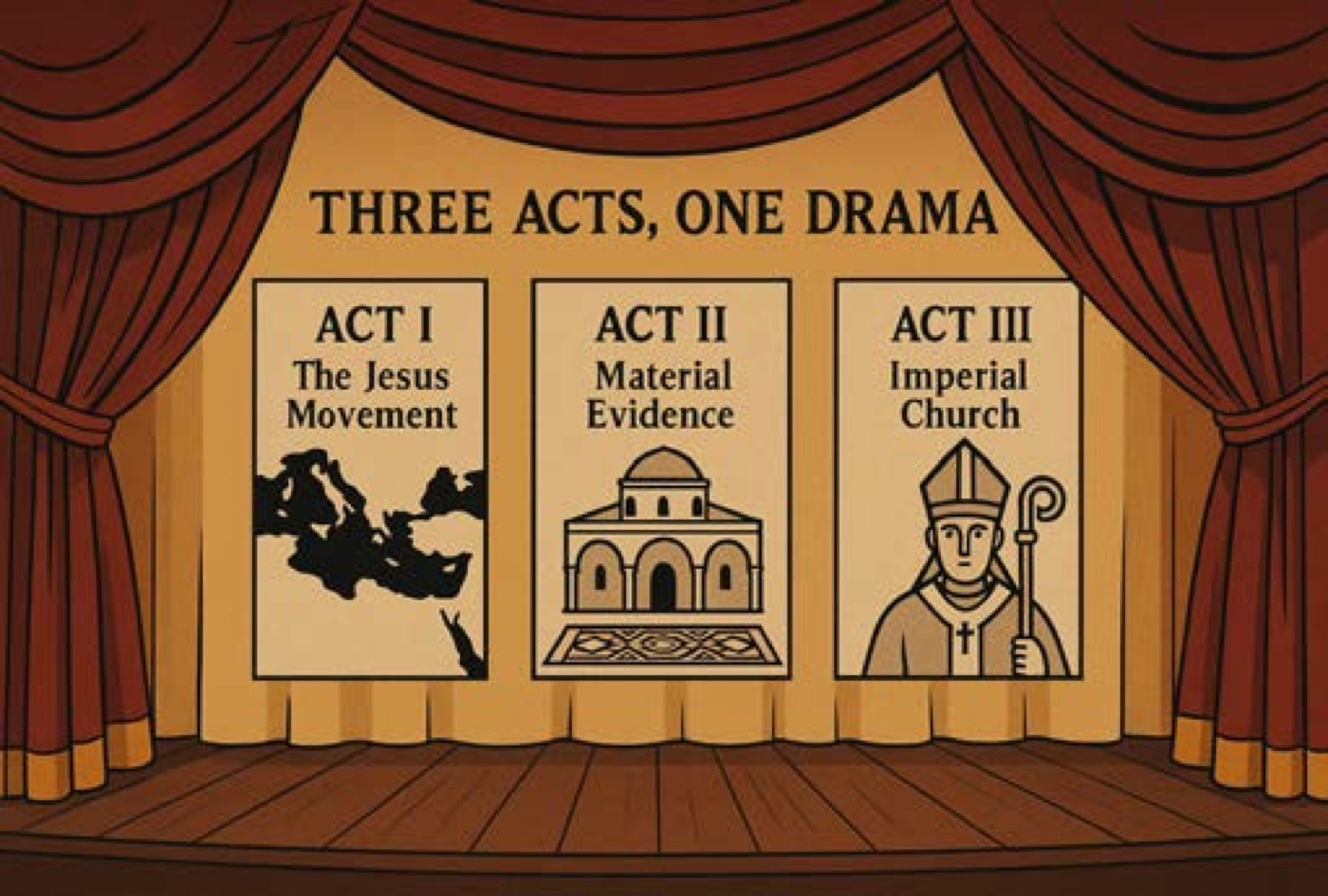
The final movement of the episode shifts from chronology to structure. It asks the listener to imagine the whole history as a curve: scattered points, clustering, alignment, rapid rise, instability, fracture, and redispersion. That visual model makes the real hinge visible. The crucial point is not the age of cathedrals, popes, or imperial power, but the earlier world before any of that existed: small communities scattered across the eastern Mediterranean, meeting in houses, arguing over letters, telling different stories about the same man, and responding to events they believed had happened without understanding what they were creating.
Key themesReligion as inherited memory across generations. The five-age structure of the series. Christianity as one phase within a longer Judeo-Christian inheritance. Early plurality before canon, creed, and institutional enforcement. The structural hinge before one stream becomes dominant. History as contingent development rather than a single inevitable line.