Rome is the city we are most tempted to read backwards. In the first two centuries it produced no gospel, no theology, no leadership. What Rome did produce was administration - and that, eventually, would matter more than theology.
Season 1 · Episode 10
This episode argues that Rome is the city most easily misread backwards. In the first two centuries it is not the birthplace of Christianity, not a center of theology, and not yet the obvious seat of authority. What Rome develops instead is something more consequential for the future: administrative machinery, burial control, curated memory, succession claims, and the practical habits of governance that later allow Christianity to standardize time, define norms, and enforce a single structure after imperial alignment.
The episode begins by stripping away later assumptions about Rome. In the first two centuries, Christianity is still overwhelmingly an eastern movement, shaped by Aramaic and Greek, and debated in Jerusalem, Antioch, Syria, Alexandria, and Asia Minor. Rome stands at the edge. Paul’s letter to the Romans shows not Roman leadership but Roman absence; Acts brings Paul to Rome only at the end, under arrest, and then falls silent. There is no early Roman theological school, no Roman gospel tradition, and no major doctrinal initiative emerging from the city.
What Rome does develop is practical coordination. Christianity there grows among slaves, freed people, immigrants, artisans, and women outside civic power. It is household religion: dense, urban, domestic, and forced to survive by logistics rather than brilliance. Roman Christians learn to organize aid, manage disputes quietly, preserve communal belonging, and operate at scale without attracting unnecessary attention. The city’s first real Christian contribution is therefore not theology, but administration.
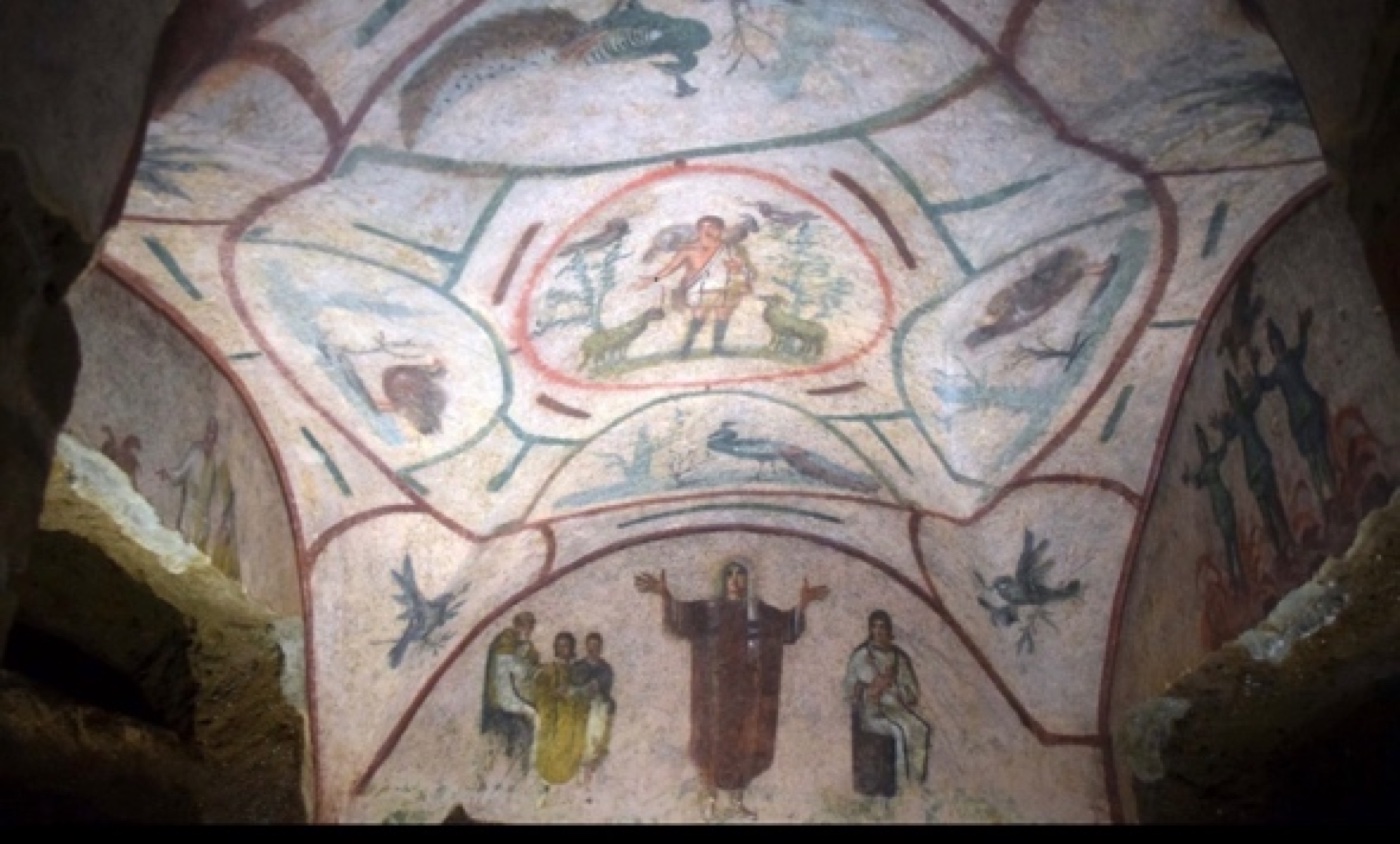
That administrative instinct becomes especially visible in burial and memory. Roman Christians bury their dead rather than cremate them, forming networks of catacombs that begin as archives of care rather than monuments of orthodoxy. Over time, however, burial becomes a form of control. Martyr lists are curated, anniversaries fixed, rival memories excluded, symbols standardized, and belonging made visible through managed space. Rome learns that control of memory does not require control of belief. If you govern the dead, you begin to shape the living.
The same pattern appears in succession. Rome does not simply inherit apostolic authority; it gradually constructs it. Early episcopal lists, especially from the late second century onward, turn scattered names into a line of continuity and present continuity itself as proof of truth. The point is not yet papal monarchy in the later sense, but norm-setting: defining legitimacy, smoothing gaps, and making disagreement appear as deviation. Persecutions then act as institutional stress tests, forcing Rome to answer practical questions about the lapsed, rival bishops, re-entry, schism, and authority. By the late second and third centuries, Rome possesses a unique combination: machinery without empire. It cannot yet rule, but it can model rule.
That is why Constantine matters in this episode only at the end. Rome does not invent authority under empire; it receives imperial energy at the moment when its mechanisms are already in place. The city that learned to coordinate households, curate burials, manage disputes, and construct continuity is now able to standardize rhythms, fix norms, and enforce the calendar and discipline that earlier episodes have traced. Rome does not create the bottleneck. It becomes the executor of it.
Key themesRome read backwards; Christianity at the edge rather than the center; household religion and logistics; burial as memory management; apostolic succession as norm-setting; persecution as administrative rehearsal; machinery without empire; Rome as the executor, not the inventor, of later Christian standardization.